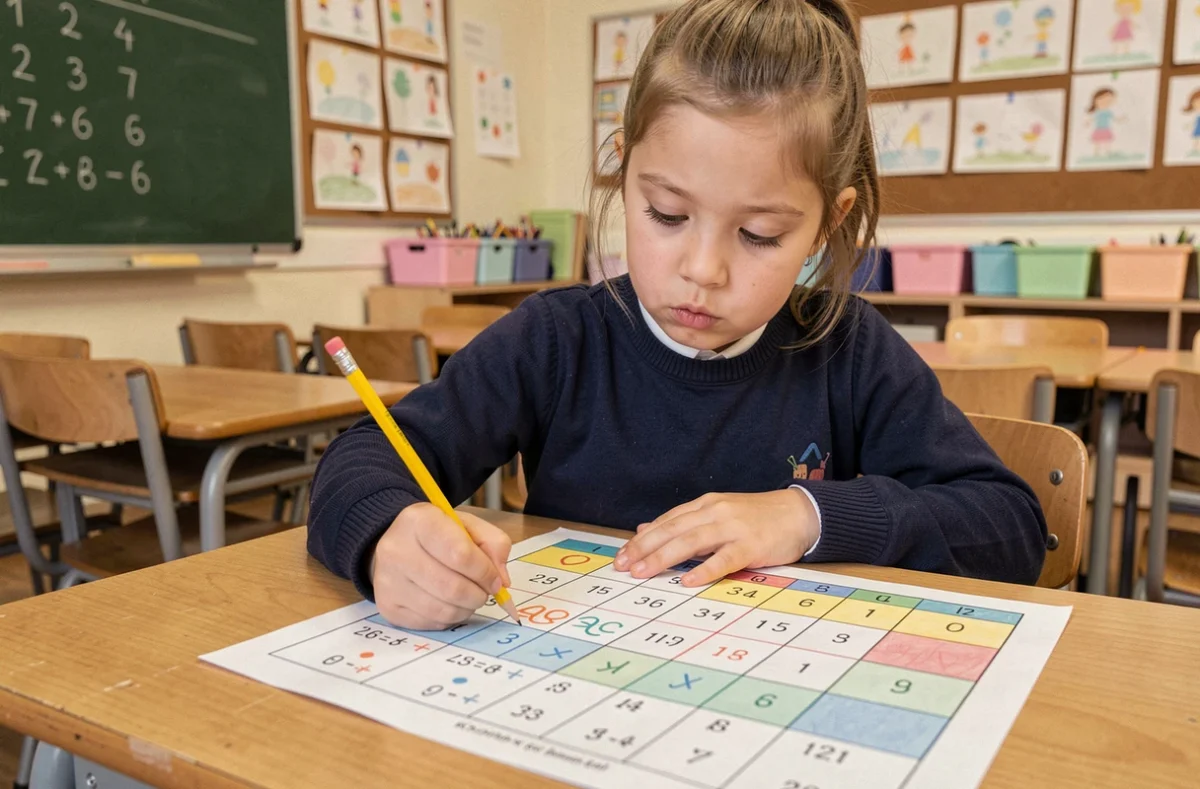
In CE2, the mathematics curriculum requires students to handle numbers up to several thousands, master multiplication tables, and reinforce written calculation techniques. The magic math coloring, used in many classrooms, associates each calculation result with a color to gradually reveal a hidden drawing. This format appeals to both students and teachers, but its actual effectiveness depends on how it is integrated into the educational progression.
Learning time versus coloring time in CE2
The central question surrounding magic coloring is less about its playful nature than about the ratio between the time spent calculating and the time spent coloring. A CE2 student faced with a sheet of twenty boxes performs twenty operations, sometimes in just a few minutes. Coloring the areas, however, can take double or triple that time.
This imbalance is not trivial. The effective calculation time often represents a minority fraction of the activity. The student who colors no longer mobilizes mathematical skills: they mechanically apply a color code. For a teacher looking to work on mental calculation fluency, the same number of operations presented in a traditional exercise format would take much less class time.
Recent educational sheets suggest structuring the session into several phases: collective warm-up, guided practice, autonomy on the sheet, and then oral assessment. When magic math colorings for CE2 fit into this framework, coloring time becomes a reward at the end of the sequence rather than a substitute for practice.

Visual correction and assessment of mathematical knowledge
One of the common arguments in favor of magic coloring concerns self-correction. If the final drawing does not resemble the expected model, the student knows they have made a mistake. This mechanism has real merit: it signals the error without adult intervention.
However, visual correction does not allow for identifying which operation posed a problem. A student who gets a wrong result on 7 x 8 and colors an area red instead of blue sees that something is wrong, but does not necessarily know where or why. The training recommendations for mathematics for cycle 2 clearly distinguish between diagnostic, formative, and summative assessment. Magic coloring does not fulfill any of these functions on its own.
For it to become a formative assessment tool, an additional step is needed: asking the student to explain their calculation procedure or proposing a short separate verification. Without this clarification, the teacher does not know if success comes from understanding or from successive attempts.
Adapting magic coloring sheets to the numbers in the CE2 curriculum
The cycle 2 curriculum provides for a progression towards four-digit numbers. Many magic colorings available online remain calibrated for simple additions or basic multiplication tables, without exploiting the specific skills expected by the end of CE2.
A relevant magic coloring at this level should involve varied operations:
- Decompositions of three or four-digit numbers (for example, identifying that 2,345 corresponds to 2,000 + 300 + 40 + 5 to find the associated color)
- Comparisons and bounding of numbers, where the student must place a number between two limits before coloring
- Written calculations of additions or subtractions with carrying, where the result determines the color code
- Multiplications by a one-digit number, extending the work on tables to larger products
Materials must evolve with the progression towards numbers up to 10,000. A sheet that only offers additions of numbers less than 100 no longer meets the expectations of CE2 and keeps the student in a comfort zone without new learning.
Legend and color code: a lever of complexity
The legend of the magic coloring is a parameter rarely exploited. Increasing the number of colors in the code forces the student to discriminate more results. Moving from six to twelve colors on a multiplication sheet multiplies the results to memorize and reduces the possibilities of guessing by elimination.
Conversely, a too-simple legend (three or four colors) allows finding the correct answer by visual deduction, without calculating. The student notices that most areas are blue, assumes that the most frequent result corresponds to blue, and colors without checking. A complex legend forces calculating each operation individually.
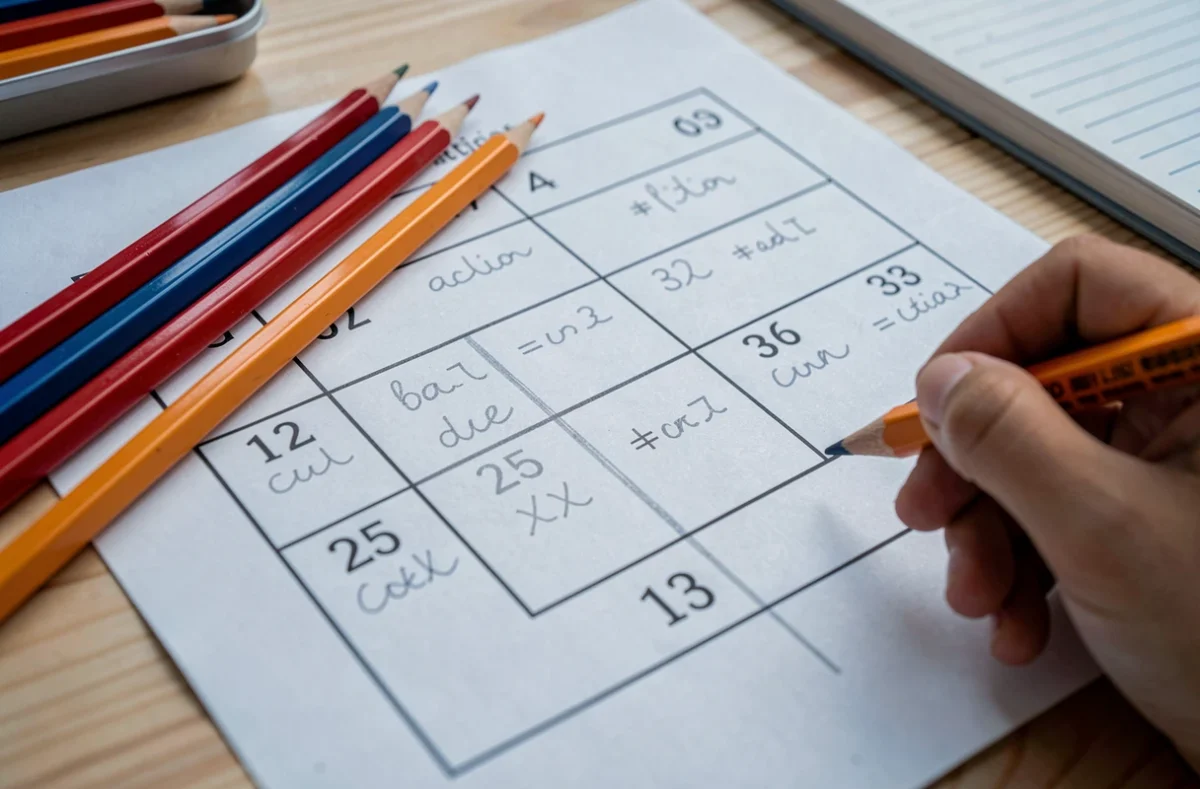
Concrete manipulation and coloring: two distinct steps in learning numbers
Recent pedagogical recommendations for cycle 2 emphasize a three-step process: manipulation of concrete objects, pictorial representation, and then abstraction. Magic coloring sits between representation and abstraction. It does not replace manipulation.
A student discovering the concept of hundreds needs to physically group cubes or tokens before moving on to written numerals. Directly offering them a magic coloring on hundreds skips a step. Coloring is more relevant as consolidation than as discovery.
This distinction changes the role of coloring in the sequence. At the beginning of the sequence, it may mask misunderstandings behind mechanical success. At the end of the sequence, after manipulation and progressive exercises, it offers additional practice where the student automates already understood procedures.
Known limits and uses to avoid with magic colorings
Several limits deserve to be clearly stated. Magic coloring does not develop the ability to justify a result. It does not work on problem-solving. It does not promote peer interaction, as each student colors their own sheet in silence.
The argument that the activity improves fine motor skills is valid in kindergarten or CP, but loses relevance in CE2 where students generally master the coloring gesture. Using a math sheet to work on fine motor skills at this level diverts from the original objective.
Field feedback varies on this point, but a simple criterion allows for a decision: if the objective of the session is mathematical, coloring should remain a dressing in service of calculation, not the main activity. When the time spent coloring exceeds the time spent thinking, the tool has changed its nature.