Navigating between different units of measurement for liquids can sometimes be complex, especially when switching from an American recipe to a European format, or vice versa. Whether in cooking, chemistry, or other fields requiring precise conversions, a few tips can greatly simplify the task.
First, it’s important to know the basic equivalents: one liter is approximately 33.8 US fluid ounces, or 4.2 cups. Using online tools or specific apps can be very handy. Having an accurate scale on hand ensures precise measurements and helps avoid often costly mistakes.
Understanding Liquid Measurement Units
The world of liquid measurements is vast and requires a precise understanding of the different units of measurement. Converting measurements in cooking is an operation that allows no approximation. To navigate easily between these units, one must master a few basic conversions.
- Centiliters: One centiliter is equivalent to 10 milliliters. 400ml to cl converts easily to 40 cl.
- Milliliters: A milliliter is a unit of volume measurement equivalent to one thousandth of a liter.
- Liters: One liter is equivalent to 1000 milliliters or 100 centiliters.
- US Gallons: One US gallon, a unit of volume measurement primarily used in the United States, corresponds to approximately 3.8 liters.
Common Conversions
| Source Unit | Target Unit | Conversion |
|---|---|---|
| Centiliters | Milliliters | 1 cl = 10 ml |
| Milliliters | Centiliters | 10 ml = 1 cl |
| Liters | US Gallons | 1 L = 0.26 US Gallon |
| US Gallons | Liters | 1 US Gallon = 3.8 L |
The art of precision is often synonymous with success in cooking. Knowledge of the units and their conversions ensures flawless culinary preparations, where each ingredient is measured accurately. Consider these concepts as essential tools to turn your recipes into true successes. 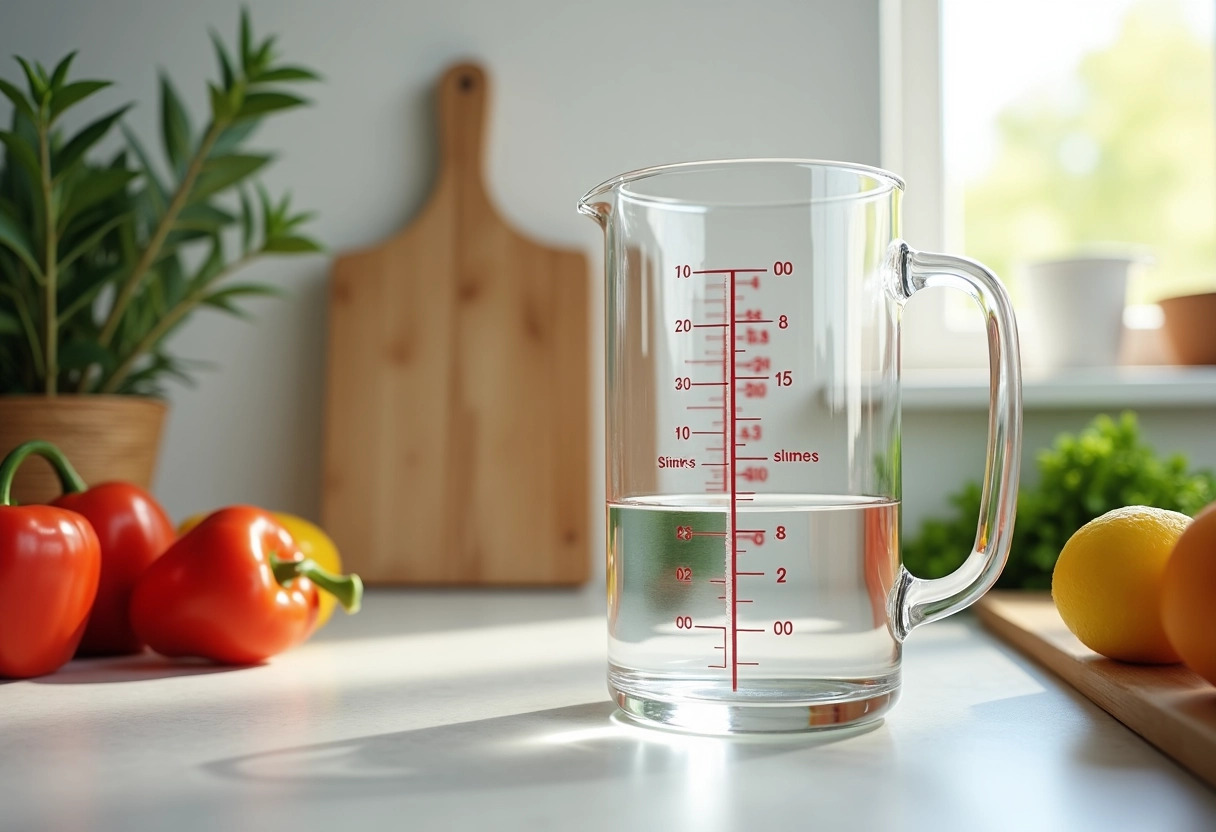
Techniques and Tips for Error-Free Conversions
Mastering conversions in cooking relies on a fine understanding of the equivalences between different measurement units. Here are some tips to ensure flawless conversions:
- Teaspoon: One teaspoon is equivalent to 5 milliliters.
- Tablespoon: One tablespoon corresponds to 15 milliliters.
- Medium Glass: A medium glass is equivalent to 200 milliliters.
- Medium Bowl: A medium bowl holds 250 milliliters.
- Large Bowl: A large bowl is equivalent to 500 milliliters.
Using Accurate Measuring Tools
To avoid mistakes, use appropriate measuring instruments. Digital kitchen scales and graduated measuring cups in milliliters and liters are your allies. They allow you to measure the volumes needed for your recipes accurately.
Adopting Visual References
In the absence of precise measuring tools, rely on common visual references:
- A coffee cup corresponds to 100 milliliters.
- A wine glass also holds 100 milliliters.
- A tea cup is equivalent to 200 milliliters.
Temperature Conversions
Temperature conversions are also essential, especially in baking. Here are some useful equivalences:
- 0° Celsius = 32° Fahrenheit.
- 100° Celsius = 212° Fahrenheit.
- 180° Celsius = 350° Fahrenheit.
- 210° Celsius = 410° Fahrenheit.
By integrating these techniques and tips into your culinary practice, you ensure accurate conversions and culinary results without surprises.