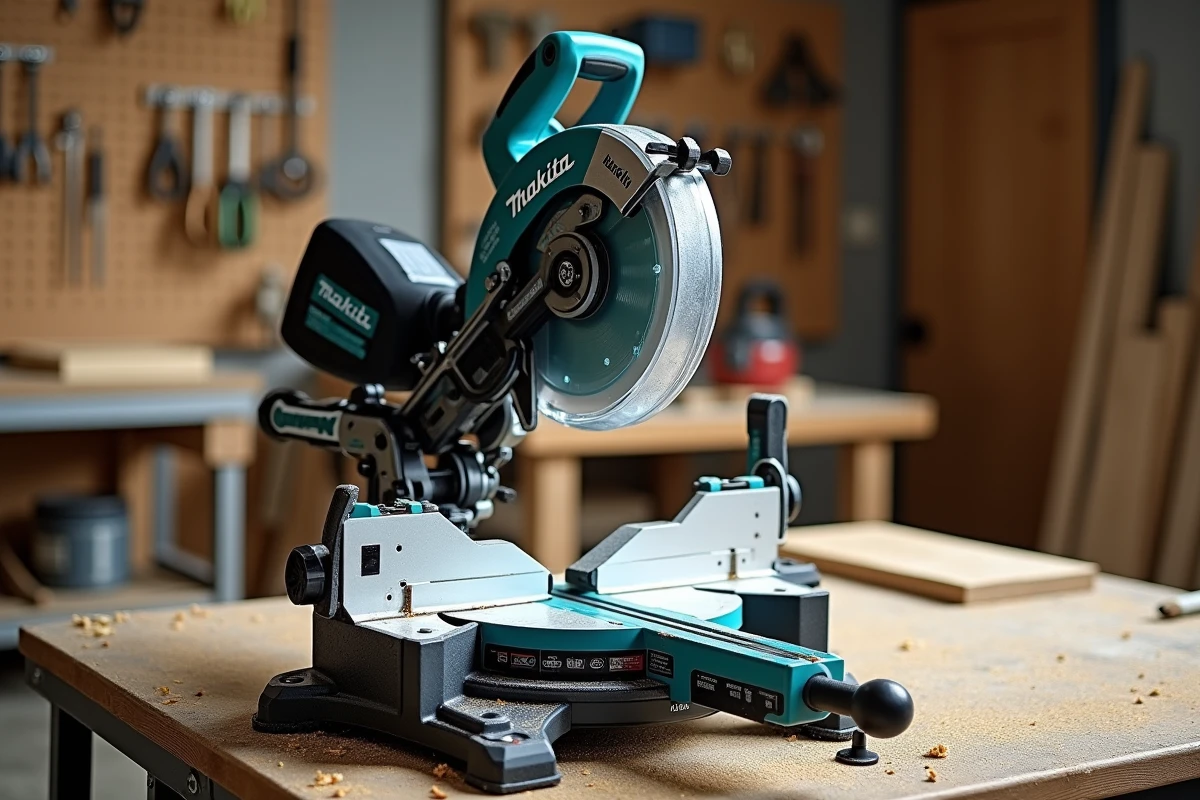
The Makita LS1018L is a radial miter saw equipped with a 1430 W motor, a 260 mm blade, and an idle speed of up to 4300 rpm. This model, designed for miter and bevel cuts on wood and derivatives, features a laser cutting guide system. With its 825 mm width and weighing just under 20 kg, the machine falls into the semi-professional segment of the Makita range.
Rear Slides of the LS1018L: A Technical Choice That Dates Back
The feature that immediately distinguishes the Makita LS1018L from newer models is its rear sliding rail system. To perform a radial cut, the saw head retracts on two metal bars that extend behind the frame.
In practice, this mechanism requires leaving a significant space between the machine and the workshop wall. On a workbench pushed against a partition, the rail travel is simply blocked, which reduces the radial cutting capacity to zero.
Manufacturers (including Makita, with the LS1019L and LS1019L2 models) have since migrated to front sliding systems or compact fixed rails. These mechanisms allow the saw to be placed against the wall without sacrificing cutting width. For a spacious workshop or job site with ample space, the rear slides of the LS1018L pose no problem. In a small room or cluttered garage, this rail retraction becomes a daily constraint.
Before investing, it is worth measuring the available depth on the intended work surface. About thirty centimeters of free space behind the machine is a realistic minimum to utilize the full travel.

Dust Extraction: The Weak Point to Anticipate on This Makita Saw
Dust management is a recurring issue with radial miter saws, and the LS1018L is no exception. The original dust extraction port is not sized to connect directly to modern job site vacuums (Festool, Bosch, or even the Makita Xtract range).
Several users report that a diameter adapter or a DIY setup is necessary to achieve proper capture of chips and fine dust. Without effective extraction, sawdust accumulates around the rotating table and eventually obstructs the reading of angle graduations. For everything you need to know about the Makita LS1018L and its technical specifications, these dust extraction details are among the elements to be aware of before purchase.
- Check the diameter of the original port and compare it to that of the planned vacuum hose (often a difference of a few millimeters is enough to ruin the seal).
- A soft rubber reducer, tightened with a clamp, is usually sufficient to solve the problem for a few euros.
- Setting the extraction to automatic mode (synchronized triggering with the saw) significantly improves cutting cleanliness during long sessions.
This flaw is not a dealbreaker, but it should be budgeted for right from the purchase. For a machine sold in this price range, one would expect direct compatibility with common extraction systems.
Guiding Laser and Cutting Precision on Wood and Skirting Boards
The integrated laser projects a red line onto the workpiece to mark the cutting line. On skirting boards, moldings, and battens, this visual marker speeds up positioning and reduces the number of pencil lines.
However, the accuracy of the laser line depends on the initial adjustment. Out of the box, the laser often requires calibration to align exactly with the blade’s path. The procedure is described in the manual and requires an Allen key and a few test cuts on a scrap piece of wood.
Once calibrated, the system operates reliably for common miter cuts (45°, 22.5°). For compound cuts (miter + bevel), the laser projection remains useful but does not eliminate the need for a protractor or square check, especially for visible joints like frames or window casings.
Cutting Capacity and Compatible Materials
The 260 mm blade allows for working with generously sized pieces, sufficient for most high skirting boards and common paneling. The motor’s power also permits cutting medium-density panels (MDF, fine melamine), provided the feed speed is adjusted accordingly.
For hardwoods like oak or beech, the machine performs well as long as the head descent is not forced. The quality of the original blade is adequate for regular cutting, but replacing it with a fine-toothed blade (60 teeth or more) significantly improves the finish on visible cuts.
Used Makita LS1018L: A Legacy Model at a Reduced Price
The LS1018L is being phased out from the catalog at several European distributors, gradually replaced by the LS1019L and LS1019L2. This situation creates an interesting purchasing window: clearance stocks and the second-hand market offer the machine at prices significantly lower than the initial catalog price.
For a used purchase, priority check points focus on the condition of the slides (side play), wear on the rotating table, and the functioning of the laser.
- Test the smoothness of the rail sliding by pushing the head back and forth without the blade rotating: any hard point indicates wear or lack of lubrication.
- Check that the miter lock engages clearly on the predefined positions (0°, 15°, 22.5°, 31.6°, 45°).
- Request a test cut on a batten to verify the actual precision and the condition of the blade.
A well-inspected used model remains a high-performing radial saw for an amateur or semi-professional workshop. The fact that it is an end-of-commercial-life model does not affect the machine’s mechanical robustness, and Makita spare parts remain available.
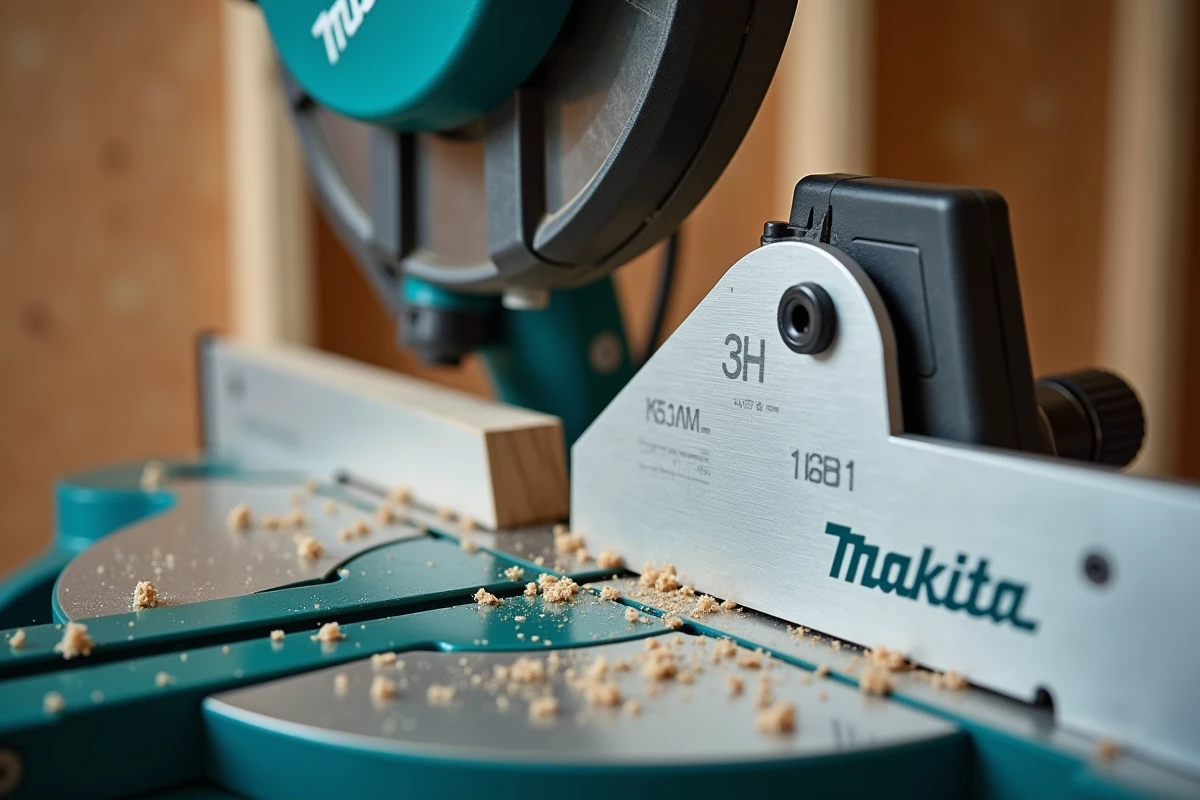
The Makita LS1018L retains its cutting qualities and robustness, but its rear slide architecture and non-standard dust extraction port place it behind the next generation of radial miter saws. For a new purchase at catalog price, the successors LS1019L offer a better compromise between size and performance. However, at a discounted price on the second-hand market or in clearance, the LS1018L remains a solid choice for those with the necessary space.