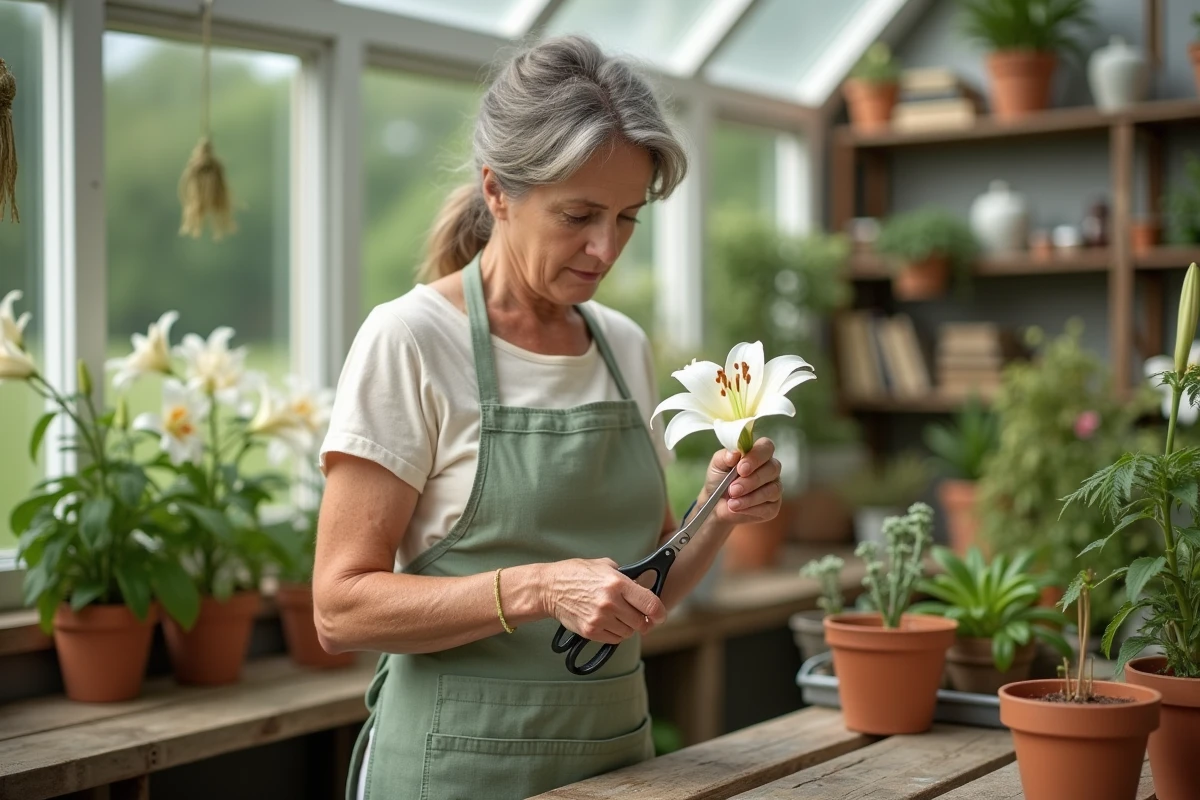
You have just received a bouquet of lilies and, a few hours later, an orange stain adorns your tablecloth or shirt. The culprit is not the petal, but the fine golden powder produced by the flower’s reproductive organs. Cutting the pistil of the lily (or more precisely its stamens) helps avoid this inconvenience and allows you to enjoy the flower longer. You just need to know what to remove, when, and how.
Stamens or pistil of the lily: what you are really cutting
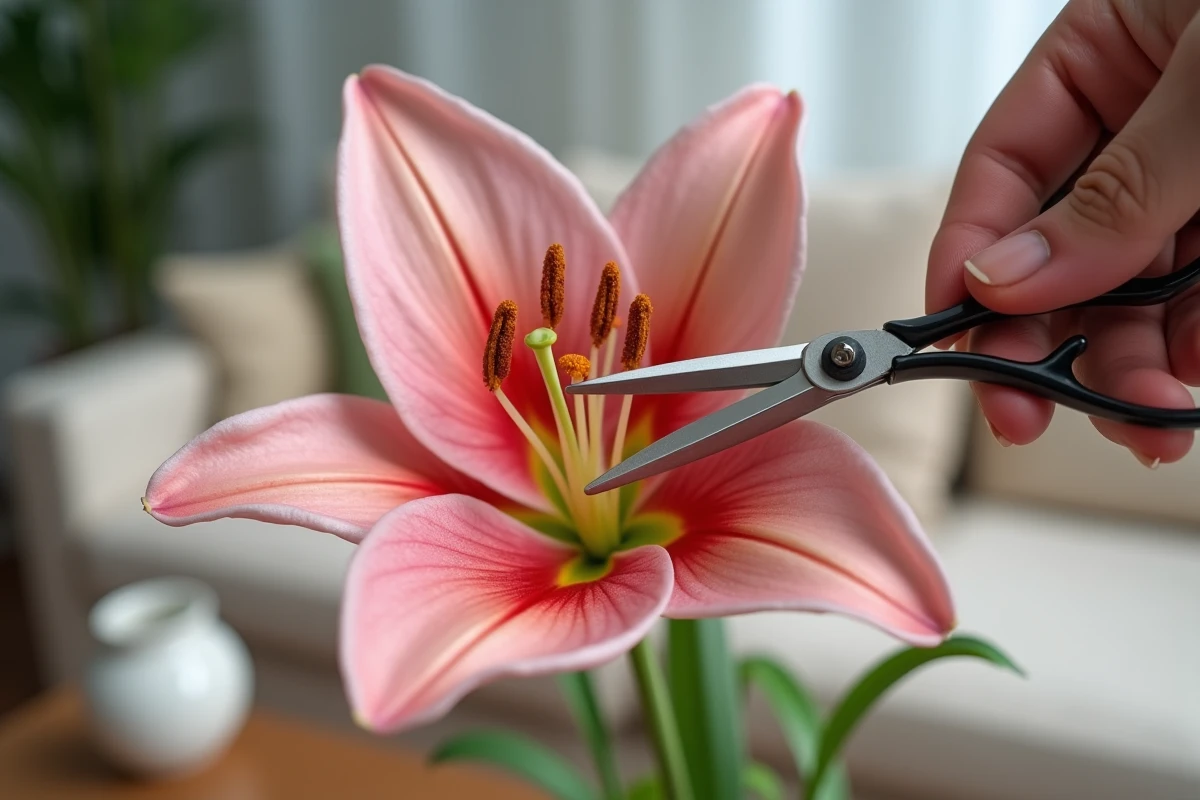
Confusion is common. Many guides talk about “cutting the pistil,” while the problematic organ is the stamen. The pistil is the female part, located at the center of the flower: a tube topped with a sticky stigma. It does not produce pollen.
The stamens, on the other hand, surround the pistil. Each stamen consists of a long filament and an anther, this small elongated sac that releases pollen. It is the anther loaded with pollen that stains, not the pistil. In common language, “cutting the pistil” actually refers to the removal of the stamens and their anthers.
Why does this distinction matter? Because by removing only the stamens, you eliminate the source of pollen without touching the pistil or weakening the structure of the flower. If you already know the principle and are looking for the details of the gesture, you can learn how to cut the pistil of the lily with a step-by-step guide tailored to each situation.
Lily pollen and stains: why act before full opening
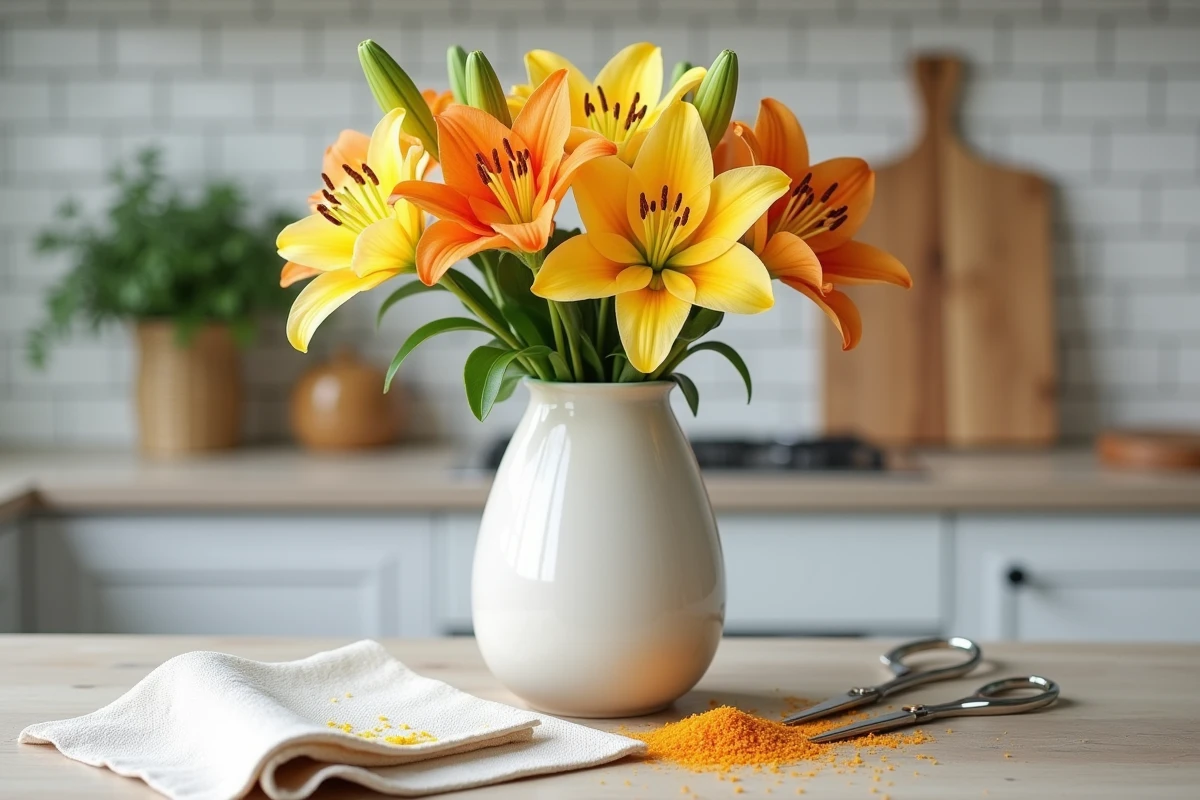
Lily pollen is not ordinary pollen. Its orange or brown pigmentation adheres to textile fibers and porous surfaces with rare tenacity. Once embedded, it resists regular washing and can leave a lasting mark on light fabric.
The ideal time to remove the stamens is just before the bud fully opens. At this stage, the anthers are still closed and the pollen remains compact, almost dry. You can grasp it without it dispersing.
Waiting for the flower to be widely open complicates the task. The anthers open, the pollen becomes powdery, and the slightest contact projects it onto the petals, the vase, or the table. If you intervene too late, a simple draft is enough to spread the powder around the bouquet.
Intervening too early, an underestimated risk
Conversely, removing the stamens from a bud that is still very closed can damage the forming petals. You risk tearing the corolla by forcing access to the center of the flower. The right indicator: the petals begin to separate, and you can see the anthers without having to force the opening.
Technical gesture: removing the stamens from the lily without damaging the flower
The operation is simple as long as you follow a few precautions. Here’s how to proceed:
- Work on a surface that is easy to clean (sink, countertop protected by newspaper). Pollen sometimes falls despite your precautions.
- Hold each stamen between your thumb and index finger, at the filament level, just below the anther. Gently pull downward with a steady motion. The stamen detaches easily without tools.
- If the anthers have already started to open, use a paper towel to pinch them. Never rub an open anther with bare fingers: the pressure crushes the pollen and fixes it to the skin.
- Immediately throw the removed stamens into a bag or closed trash can. If left on the countertop, they continue to release pollen.
Some florists recommend cutting the stamens with small fine scissors or tweezers. Both approaches work. Hand removal remains the fastest method for a home bouquet.
Should the pistil also be removed?
The pistil does not produce pollen. Removing it does not provide any benefit against stains. Keeping the pistil preserves the natural silhouette of the flower: this small central tube gives the heart of the lily its characteristic relief. Removing it leaves a hollow center, which is less aesthetic.
The only exception concerns a very minimalist decorative use where a perfectly smooth petal is desired, with no visible organ in the center. In this specific case, removal is an aesthetic choice, not a practical necessity.
Care for lilies in a vase after removing the stamens
Removing the stamens alone does not guarantee a lasting bouquet. What follows depends on the quality of the water and the environment.
Change the vase water every two days and re-cut the stems at an angle of about one centimeter with each change. This action reopens the absorption channels and allows the flower to continue hydrating properly.
Place the vase away from a direct heat source (radiator, south-facing window). Lilies do not tolerate dry heat well, which accelerates petal wilting. A cool, bright room without direct sunlight is best.
- Remove any leaves that are submerged in water: they rot and promote the proliferation of bacteria.
- Avoid placing the bouquet near a fruit bowl. Ripe fruits emit ethylene, a gas that accelerates the senescence of cut flowers.
- If one flower wilts before the others, remove it. A wilted flower releases ethylene which accelerates the decline of neighboring flowers.
Potted lilies in the garden: the question of reproduction
For a lily grown in the ground or in a pot, removing the stamens has an additional consequence: you eliminate the possibility of pollination. The plant will not produce seeds.
If your goal is purely decorative, this is not an issue. Removing the stamens can even slightly prolong the flower’s hold on the stem, as the plant no longer expends energy on pollen maturation.
On the other hand, if you wish to collect seeds to multiply your lilies or observe the complete life cycle of the plant, keep the stamens intact. The choice depends on the use: decoration or reproduction. Both approaches are valid, but they mutually exclude each other on the same flower.
One last often-forgotten point: Asian lily varieties generally produce less fragrance than Oriental lilies, but their pollen is just as tenacious. Removing the stamens remains relevant regardless of the variety, as long as you want to protect your interior from stains.